Posts

Showing posts with the label Rwanda

Bubble wrap

Image
  I am holding the candle holder my godchild modelled and glazed. I reach behind me into a box full of wrapping material. A piece of tissue paper, then a sheet of bubble wrap. That’s it. Nicely wrapped. I place it in my trunk. Safe, for a long journey. It's that time again. I'm packing up my house. Well, it didn’t feel like my house anymore in recent weeks, as furniture disappeared, and curtains were taken down. The garden is already showing signs of neglect. I am moving out. Again. With the cups, plates, baskets, and books, I am also packing up my life in Rwanda. I see the densely populated hills, the rice in the valleys, the black and white stones at the edge of every road, the children running with me - shouting loudly "mzungu"- as I pass them on my bicycle. I muse on the eventful years I spent here: of COVID times, of austerity and other challenges. I think about the resilience and will of the people I work with, about how we worked together. How we conquere...
Intruder

Image
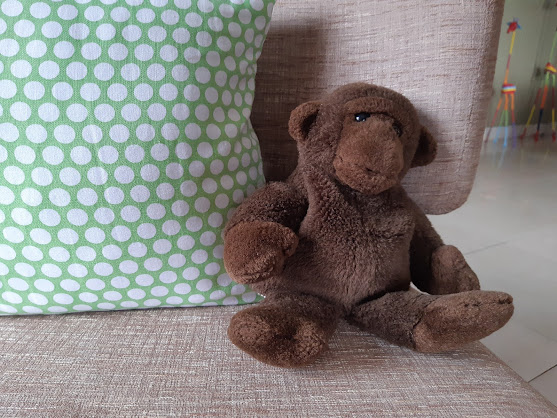
  Saturday afternoon. I have just come home from the fruit and vegetable shop. Two heavy shopping bags are strapped to my scooter. I untie the stretchers and drag them one by one to the front door. I unlock the door and kick off my shoes. Whew, now to carry the bags to the kitchen. I walk through the living room and see that Staf the Giraffe has fallen over. Staf is a South African giraffe made of iron wire and beads. Three of those giraffes stand in a row. Staf is the smallest and sometimes a bit unstable. He sometimes falls over when I bump into him. My brain registers it as I walk past it. Staff is on the floor. But he wasn't on the floor when I left. Did I bump into him on my way out? I enter the kitchen. There are two objects on the floor there. The first is a dish of cockroach poison that is otherwise neatly shoved under a rack. It now lies a meter from that spot. There is also a crocheted coaster on the floor. This one is normally lying on my coffee table, in the living ...

Belgian endives

Image
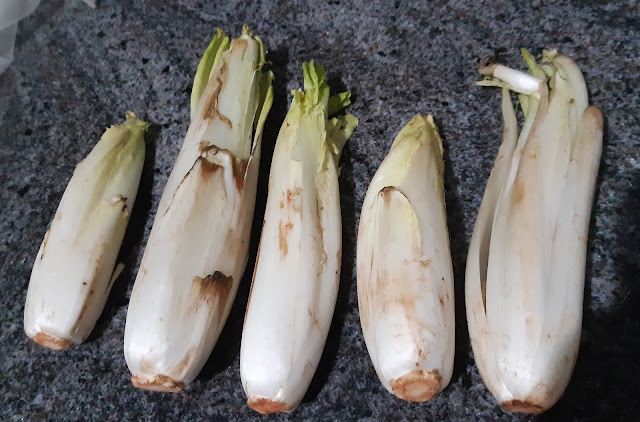
"Guess, what I found in Go Green?", is my message to a Belgian colleague in Rwanda. Attached is a picture, the one you see above. Go Green is the shop where I buy almost all my fruits and vegetables. When I was recently here, I just went to the market, as I did in Vietnam. But that didn't last long. The market near here is small and a bit dirty. The produce is often not so good quality either. So I went to Kimironko market. A very big market, which tourists also like to visit. I was a bit overwhelmed there. My bag almost snatched from my hand by someone who wanted to help me carry. Others following close. Since I had no idea of prevailing prices, I couldn't haggle properly, had the feeling I was cheated. On the way home, I thought: not again. Supermarkets are not really an alternative. Most supermarkets here have a very limited fresh food section. Tomatoes, onions, potatoes, papayas and bananas. But not much else. Go Green, then. Nice and easy: not so far, ever...

Bats

Image
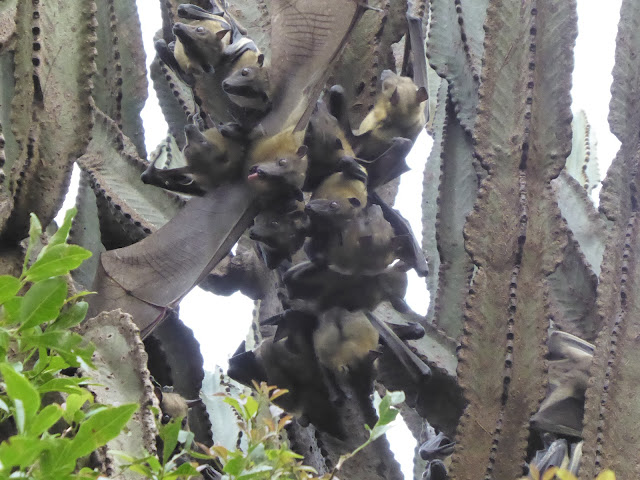
It is actually far too late when I step out of the door. Another busy day behind me. In the car park, only my bike is left. The night watchman opens the gate for me and I toil up the steep slope. It is dark, but not quite yet. The clouds contrast darkly with the rest of the sky. When I reach the main road, I hear the sound. A loud twittering, croaking. It's hard to describe, but I know what's going on. Time to get off my bike and look up in the safety of the pavement. The sky is dotted with dark, flying animals. They look like birds, but they are not. Bats. There is a large colony African fruit bats that houses in the trees a little further up. If you step past you can smell them. There must be a lot of dung under those trees. During the day they hang quietly down a branch, taking a nap. Well, quiet is not the right word either. There is actually constant movement in that big hanging animal pile. There's always one stretching its wings, not content with its spot under the...

Dust

Image
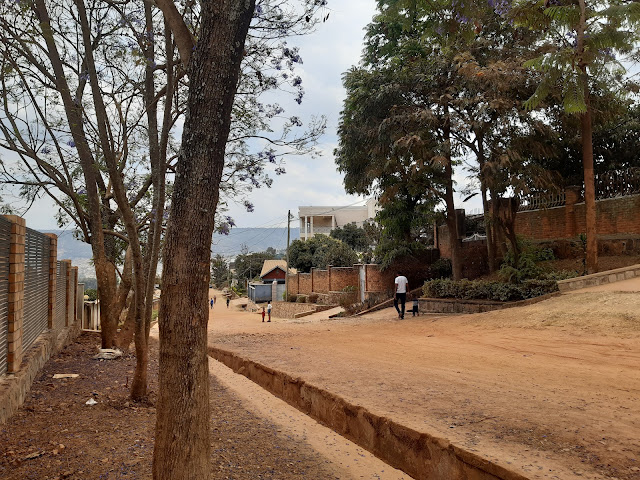
  It is dry here, very dry. It hasn't rained since May. That's normal. If all goes well, the rainy season will start again in September. The grass around my house is barren. The plants in the garden are covered with a layer of sand. I live at a dirt road. Apparently there is a system here in Kigali that works as follows: if residents of a street – not a major traffic artery of course - are willing to invest a substantial amount themselves, the municipality will supplement the cost and pave the street. But that has not happened here as yet. A dirt road, that generates dust, especially in the dry season. An unpaved road is preferable to a bad asphalt road, at least if it is maintained from time to time. A road grader, with some kind of scraper attachment, then repairs the road surface. Moving back and forth across the road the grader removes washboard ridges, potholes and other irregularities. But when a car drives on it, it is automatically followed by a cloud of dust. M...

When a seed becomes a tree

Image
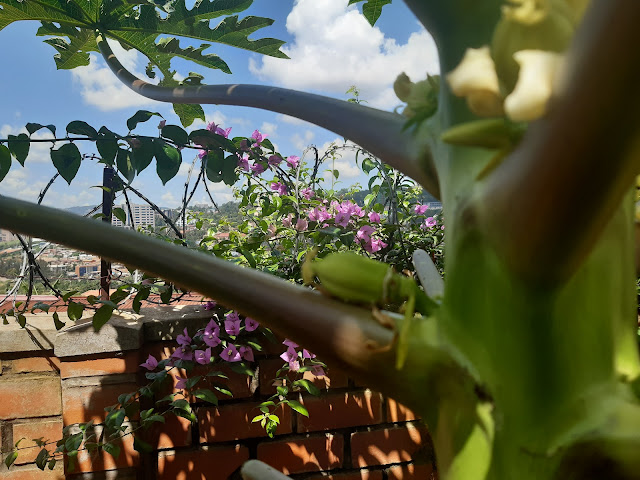
I have wanted to grow my own papayas for a long time. I undertook several attempts. First, I planted some seeds from a fruit I just ate. No success. Even though I literally looked the plants out of the ground, the seeds remained hidden in the topsoil. A little later, I saw plants germinating on my compost heap. I carefully scooped them out of the heap and planted them neatly in a pot. They didn't like that. They died one after the other. Not a success either. The plan went on ice for a while. Until a few months ago, when I decided to use my compost to enrich the soil in my vegetable garden. A week later, every inch of free space had been taken up by little germinating plants unknown to me. The insight came when those first baby leaves gave way to the more recognisable leaves. Papayas, papayas everywhere. They came as if grass had been sown. So, I weeded and left one here and there to grow big and strong. I transplanted those young plants, about 20 cm high, into the soil, between ...

Termites

Image
  Anyone who has ever lived in the sub-tropics or tropics knows them: termites. Small, industrious creatures with shiny heads and pale bodies. They are often mistaken for ants, but they are not even related to those. They make beautiful castles of sand and earth, where the colony -in an ingeniously created microclimate- works and lives in an intricate society. But they are not only found in those beautiful termite mounds. I have a small vegetable garden. There, I grow tomatoes, which are tied up on canes. Those canes get shorter and shorter. Because they get eaten at the bottom, the part that sits into the earth. Hungry termites in action. In big concrete boxes, I also have strawberries, or at least, I try to grow strawberries there. But there are many competitors around. Snails love the unripe fruit. After they have made their move, fruit flies finish their work. Then, when a fruit does escape those predators and shines red between the green leaves, a mouse bird will come an...

Remember

Image
(Visual graphic from https://www.kwibuka.rw/)   Good Friday is a day of silence for Christians worldwide, the day when the death of Christ is remembered. This year, Good Friday was on 7 April. Here in Rwanda, 7 April is a day etched in the collective memory. It is the day of the start of the genocide against the Tutsi, 29 years ago now. In 1994 a ruthless massacre took place. The immediate trigger was the shooting down of the plane in which the then president was returning from peace talks. The plane's debris landed in the garden of the presidential villa. However, the cause was much more complex and had its roots in years of abuses, attacks, discrimination, exile, bad governance both before and after the colonial period. On 8 April, 10 Belgian paratroopers were killed. Belgium decided to withdraw its troops from the peacekeeping force that was already here, making the UN peacekeeping mission even more flimsy than before. It opened the door to an unprecedented and very wel...

Hear, the rain is coming

Image
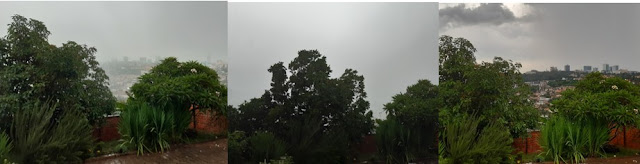
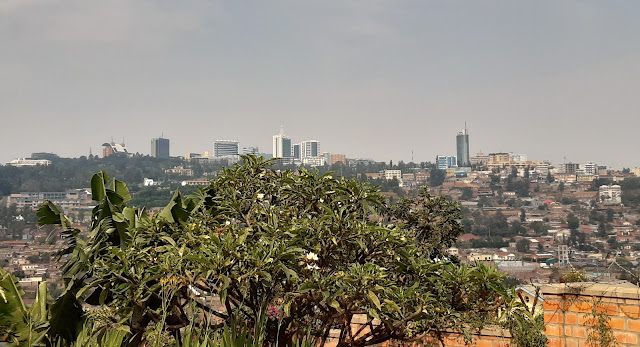
  A phenomenon I experienced here for the first time is the fact that you can hear the rain coming. Yes, you read that correctly. You can hear if rain is coming. In this region, rain often falls in heavy downpours. Tropical showers with a force you rarely see in Europe. In Rwanda, het country of the thousand hills, those showers can be very local. One hill is transformed into a muddy mush and on the hill next to it the dust is still enthusiastically blowing in your nose. But usually that storm moves gradually over the city. Where I live I look straight at Kyovu, another hill. That's where the business heart of the city is and therefore where most of the tall buildings are located. When a storm hits that area first, that stretch of hill just disappears from view. The heavy rains form a curtain with no see-through. But even when I am not standing on my terrace watching the curtain closing, I can hear that the rain is coming. This is how it works: the rain falls with force on th...

Clover

Image
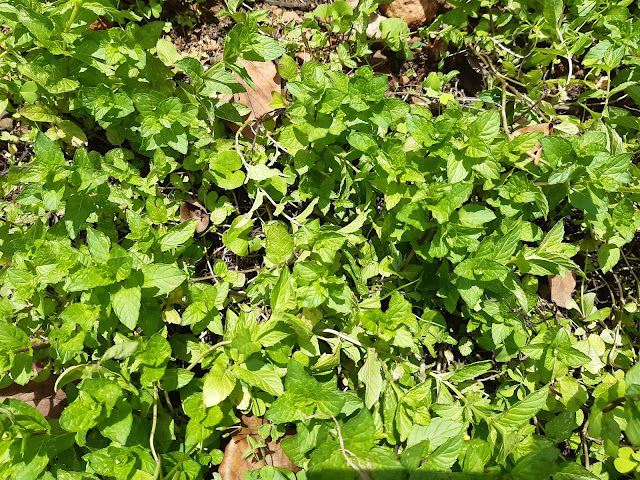
  Everything is wet and muddy after a week of heavy rain. More than 160mm in a few days. Everyone suspects that this is the start of the rainy season. We are not sure, though. Here too, the seasons (normally two wet and two dry seasons a year) are no longer clearly defined. They come later or earlier, they last longer or shorter, are drier or wetter. That causes concern in a country where a lot of people depend on agriculture. But today a cautious sun peeps through the clouds. Time to do some work in the garden. The grass that still looked parched last week is already green again. Incredible how quickly that turns around. In the vegetable garden, I see that the weeds are growing faster than the tomatoes and beans. That needs some tidying up. There is so much clover among the mint that my next mojito might have a different flavour. That mint needs some breathing space. A little later, I am crouching among the mint. Hands full of mud, looking for the clover that has grown all the w...

On number plates and emissions

Image
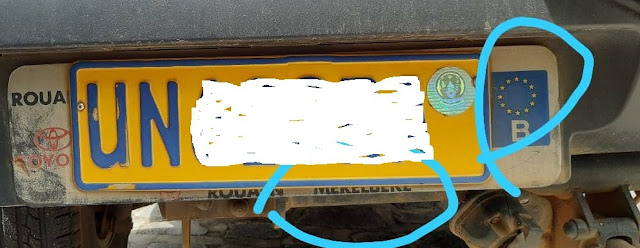
  A UN staff member in Kigali drives a car from Merelbeke, Belgium   It is an old habit when I am on the road: looking at the number plates of the cars in the traffic around me. A Swedish car in Kigali, picture LP As children, during long car journeys, we played games such as collecting as many cars of a certain nationality or collecting as many cars of a certain brand. Whoever picked "Mercedes", "Volkswagen" or "BMW" fastest on the Deutsche autobahn usually won the game. Car watching, in other words. I still do it today. In South Africa, I paid particular attention to the number plates. From those, you could tell which province the car was registered in. Personalised number plates are another interesting phenomenon. What possesses someone to drive around with "Wanted" on the car? Or "Hero"? It led to free associations and musings on the relationship between number plate, car and owner. A Dutch car in Kigali, picture: LP Here i...

Umuganda

Image
  S aturday morning. It is a bit cloudy and cooler than yesterday. Ideal to work in the garden before the sun burns too hard. I hear some birds whistling in the bushes. Nothing else. Not the sound of the heavy traffic on the connecting road across the valley. Not the voice of the woman who passes by in the street, loudly praising her goods which she carries in a basket on her head. No children playing. I hear no snatches of the gliding exercises with which the choir of a church a little lower on this hill warms up the voices. No drums or percussion either. It is silent. It is the last Saturday of the month. It is umuganda. Umuganda refers to community work that contributes to the development of Rwanda. Every last Saturday of the month, economic life falls silent from 7:00 to 11:00. During this time, everyone has to work in their community: cleaning, helping to build a school, constructing terraces, fighting erosion, you name it. The system has existed since the last century, ...

Fast road

Image
At the end of June, the Commonwealth Summit (CHOGM) took place in Kigali. More than 30 Heads of State met in Kigali. The Prince of Wales, Charles and Camilla, were also here as representatives of Queen Elizabeth. A great logistical challenge for a small country like Rwanda. And it all went well. No incidents. In the run-up to the summit, Kigali paid a lot of attention to improving its infrastructure. Suddenly, bus shelters appeared everywhere. Many roads were given a facelift, holes in footpaths were repaired and shoddy construction sites disappeared behind metres and metres of canvas advertising Rwanda's tourist assets. Perhaps the biggest challenge was getting the many roads -earmarked to ensure efficient flow of traffic during the summit- ready in time. Some roads were built, others were doubled in width. The latter also happened to a connecting road between the hill where I live and the next one. I never knew that road to be busy, but it is the fastest connection between th...

Masks off

Image
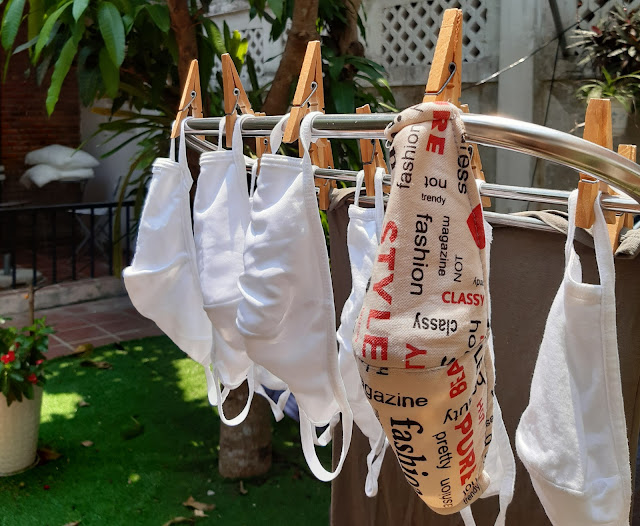
  Today is 'Face Day'. In the cabinet decision of Friday 13 May, there was an important paragraph: face masks are no longer compulsory. Unlike many other countries, in Rwanda we still had to wear face masks both outside and inside. Until Friday the 13th of May, that is. They are still recommended inside though, but it is not compulsory anymore.  For the first time since I moved here, which is over a year now, I can see the faces of the people who I pass on the street. Like today, on the way to the swimming pool. The face of the woman who walks down the street and loudly praises her fruit and vegetables in a basket on her head. For the first time, that voice has a face. The smile of the children playing with a homemade ball on the corner. The dogged expression of the man cycling a colourfully dressed woman to her destination. She is not very thin and the road goes uphill. The face of the pump attendant who tries to calculate how much change I should get. The faces of the beauti...

Cycling

Image
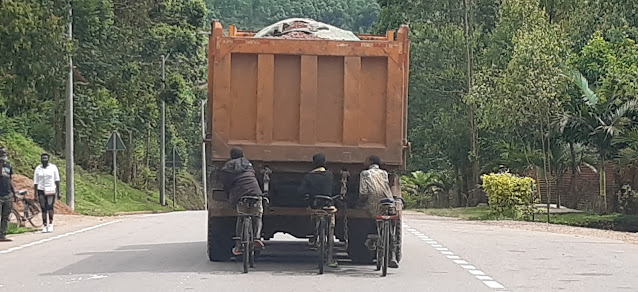
It was a small message on twitter . Rein Taaramäe, an Estonian rider with Intermarché, was on altitude training in Rwanda. He prepared himself here for the Tour of Italy. As part of that, he changed bikes. He tried out a local bike. In the video you can see how he sprints with the other cyclist, who uses Rein's bike for the occasion. Rein soon gives up, he loses with flying colours. If you pause the film, you can take a closer look at the borrowed bicycle. Yes, it has gears. But it also has an extra construction. A sort of extended carrier has been created with a cushion on it. Indeed, it is a bicycle taxi. The driver can take two or even three people on the back. In a country full of hills, this is heavy work, very heavy work. Cyclist Rein, also without passengers, losses from the taxi rider. Who has the best legs here? The film puts the concept of top-class sport into perspective. The taxi bike in the film has gears, but most bicycles used here for transporting people and g...

Pyramids

Image
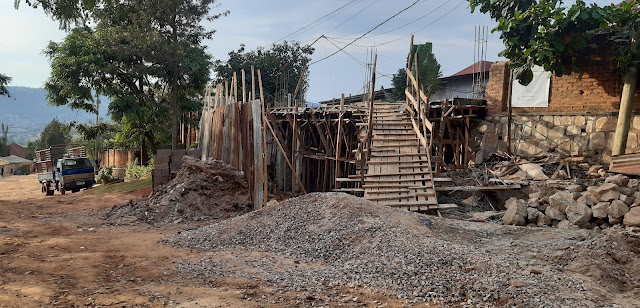
A few months ago, on a Saturday, the sound of a tractor or excavator woke me up early. That typical growl of a heavy engine, deeper and louder when the machine is doing heavy work. Slightly lighter, catching its breath, when the machine moves off and prepares for a new assault on the heavy task. Again and again. After my stay in Vietnam, I know very well what that means: a new construction site next door, or rather, opposite the door. Not exactly reassuring. Memories of the rhythmic turning of concrete mixers, the squeaking of reversing trucks with concrete (bê ton, in Vietnamese), the toiling of excavators, the shuddering of drills, the screaming of workers, the layer of cement dust on all the plants in the garden, and the smell of concrete came to mind. Anyway, things weren't going that fast here. Apart from the excavator, no other machines were involved. It was not about building a new residential tower or hotel, like in Da Nang, but about rebuilding a house. Drastic, though...

Sophia

Image
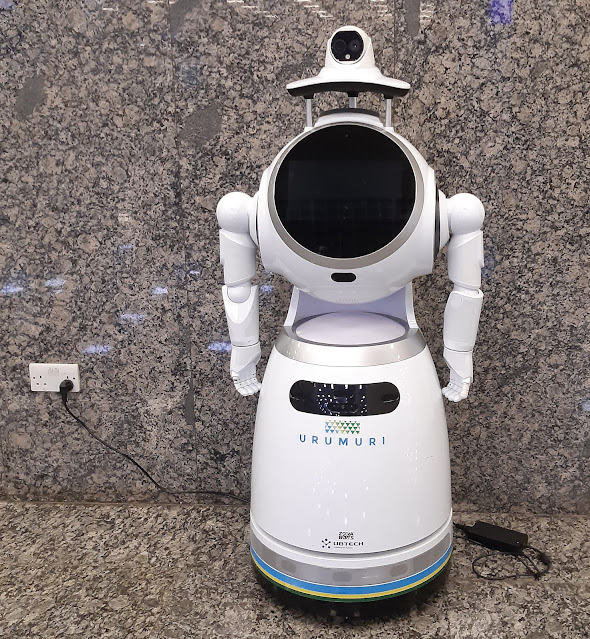
  If you are travelling in a car in Rwanda, and someone in the car says "Sophia", the driver will immediately hit the brakes. Sophia is the name used here for the hundreds of speed cameras on the roads. The original Sophia is a humanoid robot built in Hong Kong. It is one of the first robots to make an almost "human" impression through artificial intelligence. You can talk to her, she responds correctly, uses hand gestures and facial expressions. Sophia visited Rwanda in 2019 during a congress on the transformation of Africa. She made a lasting impression in a country that likes to call itself the Singapore of Africa. In the airport, there is a robot -also called Sophia- that looks a little less feminine, or even human. It supposedly can move around and measure the temperature of people in the departure hall. Yes, supposedly, because I have not yet seen the Sophia robot in action. It is always parked neatly by a wall or in a corner, charging. Anyway, everything...

Washing hands

Image
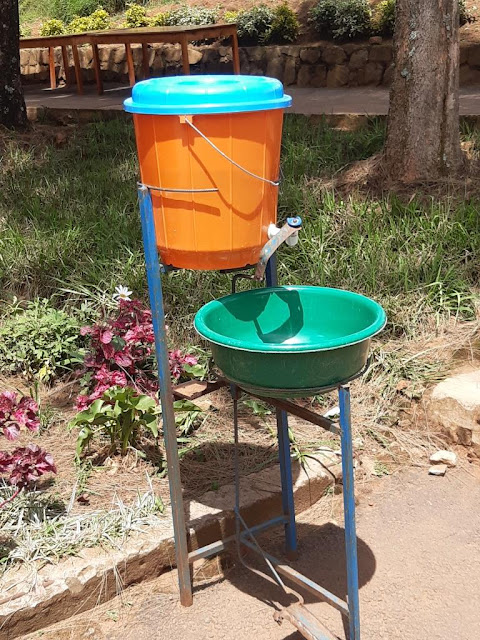
  That Boris Johnson partied while the rest of the population obeyed the coronation measures is now a fact. But we all also remember a video in which Johnson demonstrated how to wash your hands properly. While singing a cheerful song, we saw how to wash your hands. It is, of course, nice when there is running water. But what do you do when there are no or hardly any sanitary facilities? In Africa, they know what to do. Every problem gets a local solution here. Like a portable hand-washer. You see them in various designs. Some are more advanced than others. But roughly speaking, they all have at least a water tank, a catch basin or rinsing basin and some sort of metal structure on which the first two rest. The water tank can be a bucket or a plastic jerrycan. A tap is fitted to the the bottom of the tank. The metal structure has a holder, placed somewhat lower, in which a basin fits. On the side there is also a holder for a bottle of soap. This can be a bottle with a pump, the type ...

The hills are alive with the sound of music

Image
  I step out of the gate of the De La Salle teacher training college in Byumba. We are doing a training course on learning through play in pre-school. Today and tomorrow, we focus on emergent numeracy for pre-schoolers and on how you can approach that in a playful way or, more importantly, how you can use children's play to help them develop mathematical concepts. It has been a busy day, but above all, we have had a lot of fun. Like when I sent the teacher trainers armed with their mobile phones out, on a geometric figure and pattern hunt. Byumba is situated on a hill in the mountainous district of Gicumbi. In the centre of that hill is the Catholic Church. A gigantic building that seems to have been built to illustrate what we were doing today during the training. The stained-glass windows consist of geometric shapes in different colours. But what attracts me most of all is the music that flows out through the opened side door. Choral singing. I slip inside and sit down on one o...

Bags

Image
I live in Rwanda now, but I used to live in Vietnam. Of course, Rwanda and Vietnam are totally different. But what perhaps strikes me most, are the plastic bags. Or rather, the absence of bags. In recent years, many countries have taken all kinds of measures to ban single-use bags, just to reduce plastics and promote more sustainable bags. I remember how in South Africa, the bags at the checkout were made sturdier and paid for in order to reduce the amount of plastic in the litter. But even now, you see the "flowers of Africa" everywhere: bags hanging in the barbed wire of fences, flapping in the wind. In Belgium, too, people are trying to reduce the amount of plastic. The fruit and vegetable departments of supermarkets have switched from the thin bags to reusable, cloth or paper bags. But still, when visiting Belgium, it strikes me how much plastic is still in circulation, how many fruit and vegetables are pre-packed in plastic. That is less the case in Vietnam. Fruit ...